Four Questions Institutional Analysts Use to Scan the Entire Market — and How to Point Them at Your Own Portfolio
What the B2B sales desk, the strategy team, credit risk and the newsroom actually ask of management commentary across every listed company on SET and mai — with real cases where every line links back to the SEC original, and how to turn the same questions on the stocks in your portfolio that are losing margin or heading toward a default.
Four Questions Institutional Analysts Use to Scan the Entire Market — and How to Point Them at Your Own Portfolio
What the B2B sales desk, the strategy team, credit risk and the newsroom actually ask of management commentary across every listed company on SET and mai — with real cases where every line links back to the SEC original, and how to turn the same questions on the stocks in your portfolio that are losing margin or heading toward a default.
Nobody says this plainly to retail investors, so here it is: the institutional analyst does not beat you by being smarter. They beat you by asking a different question.
You open the accounts and ask "หุ้นตัวนี้ดีไหม" [is this one a buy — you have asked for a verdict on a single name]. They ask "ทั้งตลาด มีใครบ้างที่เพิ่งเริ่มพูดถึงต้นทุนวัตถุดิบที่แพงขึ้น" [across the entire market, who has just started writing about input costs going up — they have asked the market to hand them names]. The first question returns an opinion. The second returns a list.
I wrote this the first time for a team lead deciding whether to buy the tool for their desk, so it is stacked with sales, strategy, credit and newsroom cases. Then it went out, and the people who wrote in most were fundamental retail investors, saying more or less: I don't sit in any of those departments, but I want to ask every one of those questions.
So this rewrite runs both sides. Every institutional case survives intact — not one cut — because they are the evidence of what this thing was built to do. What I've added after each department is a "the retail version" box: the identical question, pointed at your own portfolio.
The five-line version
- What it does: query the management discussion and analysis (MD&A) of 926 listed companies (FY2021–FY2026) in plain Thai, and get back the verbatim text plus a link to the 56-1 file at the SEC (Thailand's Securities and Exchange Commission) on every hit
- Who is using it: analyst desks · strategy teams · credit analysis · business newsrooms — and retail investors borrowing their questions
- How to start: free, no card (100 credits/day) → DELTA ฿799/month (4 years back · 150 credits/day) → GAMMA ฿1,399/month (6 years · 350 credits/day) · annual = pay for 10 months
- Enterprise: the desk licence — multi-seat · 100-row Excel/CSV export · API into an existing pipeline. The ALPHA ฿9,900/month pack carries 10 years of depth and is open, with no buy button on purpose: seats, export volume and API rate are agreed per team, so it is scoped on the Enterprise page and the key is issued by hand (how the packs compare)
- Who you talk to: me — contact@boomleverage.com (Varanchai — former model risk / credit risk quant inside a Thai bank; this tool grew out of that work)
Map of this article — four questions, two arenas
The whole article compresses into one table. Left is what institutions pay for. Right is what you do to your own portfolio, off the identical query string.
| Query | What the institution is hunting | What you are hunting |
|---|---|---|
สร้างโรงงานใหม่ | B2B sales — companies with budget, about to spend it | The capex cycle, before new capacity lands in the numbers |
ต้นทุนวัตถุดิบแพง | Strategy — where the competition is being squeezed | Which name in your portfolio is about to lose margin |
เลื่อนการชำระหนี้ | Credit — which borrower is closest to NPL | The equity or bond whose financial language has started to tighten |
นำเข้าสินค้าจีน | Newsroom — a headline with evidence under it | A sector-wide theme before it becomes a headline |
Two columns, one system. It is the same search box. All that changes is what you intend to do with the answer.
How this works, briefly
MD&A is the management discussion and analysis section of the Form 56-1 (One Report) — the narrative where management says what happened and what is coming. It is a public document listed companies are required to disclose. Your access to it is identical to an institution's. The only difference is who has the time to read 926 companies six years back.
Risk people prize it because MD&A is text that is hard to lie in and easy to dodge in. Management rarely lies outright. They choose words, choose emphasis, choose silence — and the year-over-year drift in those choices is the signal. The pattern held up hard when I built the text-based early warning system (NLP early warning) inside a bank: plenty of credit problems announced themselves in how the story was told before the numbers actually broke.
What separates this full-market MD&A search is that it is semantic search — matched on meaning, not on exact characters. You type a question in plain Thai. The system compares that meaning against the management commentary of 926 listed companies covering FY2021–FY2026 and returns the closest passages with company name, year and a link to the source. Why that beats Ctrl-F, I set out in how semantic search differs from exact-keyword search.
Watch how one question fans out:
Your one question  →  "ใครกำลังโดนบีบต้นทุนวัตถุดิบ" [who is getting squeezed on input costs]
        │
        ▼
Matched on MEANING against management commentary, every listed company × FY2021–FY2026
        │
        ├─ Filing says "raw material cost increased"     ✓ hit
        ├─ Filing says "แรงกดดันด้านต้นทุนการผลิต"        ✓ hit
        ├─ Filing says "ราคาเม็ดพลาสติกปรับสูงขึ้น"       ✓ hit
        │        └─ None of the three contains the phrase "วัตถุดิบแพง"
        ▼
Gate: does this passage appear in the 56-1 file, word for word?
        ├─ Pass → show it + link the SEC original so you check it yourself
        └─ Fail → quarantine + report how many were held, and why
        ▼
You get "company names + the sentences they actually wrote" — not an AI summary
On the site, you type a Thai question into a search box. No code. But so the machinery is visible, I've marked conceptual code throughout this article. A single query has roughly this shape (the API is live today for teams that want it inside an existing pipeline — it is part of the enterprise desk licence, not a self-serve plan; talk to me on the Enterprise page):
# ตัวอย่างเชิงแนวคิด — บนหน้าเว็บพิมพ์คำถามไทยได้เลย โค้ดนี้แค่ให้เห็นเบื้องหลัง
from boomleverage import mdna

hits = mdna.search("สร้างโรงงานใหม่", top_k=5)   # ถามด้วยภาษาคน

for r in hits["results"]:
    print(r["ticker"], f"ปี {r['fy']}", r["period"])   # บริษัท + ปี + ไตรมาส
    print(r["snippet_verbatim"])                         # ข้อความจริงจาก MD&A (verbatim)
    print(r["source_url"])                               # ลิงก์ไฟล์ 56-1 ต้นฉบับ ก.ล.ต.
Everything hangs on the snippet_verbatim + source_url fields — every answer carries the source text unaltered plus the link to the actual file, so you can go back, read the full context and check it yourself. Not an AI summary that sounds good and cannot point at where it came from. (That is the hard line in financial research — and the same line that stops you buying a stock on a number that never existed.)
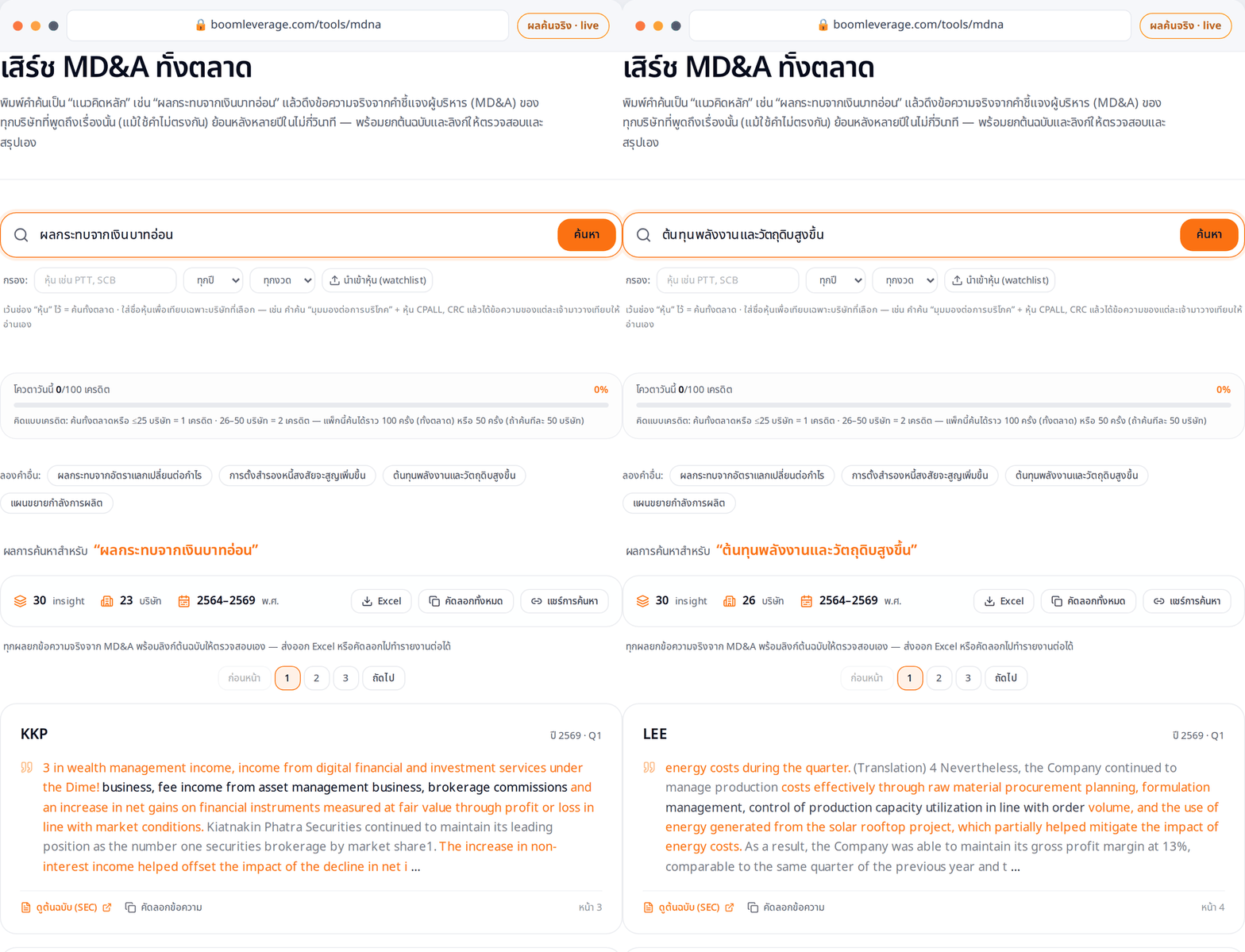
The real interface: one box, one Thai question, and the system pulls MD&A passages from every company in the market that discussed it — the matching section highlighted, the source linked for checking.
Constraints first, results second: every case below comes off the live system. The index today covers 926 companies across SET and mai, FY2021–FY2026 — every company that filed in each of those fiscal years. What constrains you is no longer coverage but depth, and depth is a function of the plan (free ~1 year and change · DELTA 4 years · GAMMA 6 years).
Department by department.
Department 1 — Sales / Business Development (B2B) — stop dialing at random, call the companies already spending
Say I'm the sales rep selling IT and software that cuts costs, or selling into contractors and machinery makers. The classic B2B problem is the random dial — a hundred calls to find the handful of people who happen to need it right now.
Invert it. Instead of guessing, ask the market directly: "ใครกำลังจะสร้างโรงงานใหม่" [who is about to build a new plant — i.e. who has already committed the budget]. A company expanding capacity has both the money and a real need: machinery, IT systems, construction, project finance.
leads = mdna.search("สร้างโรงงานใหม่", top_k=10)
for r in leads["results"]:
    print(f"{r['ticker']} (ปี {r['fy']} {r['period']}) → {r['source_url']}")
Live results — the first name up is KCE (KCE Electronics), and the better detail is that it comes up year after year, because the company kept talking about the new plant from 2022 through 2025:
KCE · 2024 (Q1): "...machinery, focusing on incorporating new innovations to ensure the new factory is modern and able to meet customer demands efficiently. The goal is to have high production efficiency, reduce energy consumption, and use resources efficiently..."
KCE · 2022 (full year): "The new factory construction has already started since Q4'2022, more progress of this project will be continually updated."
— excerpts (verbatim) from KCE's MD&A · check the original in the 2024/Q1 56-1 file at the SEC
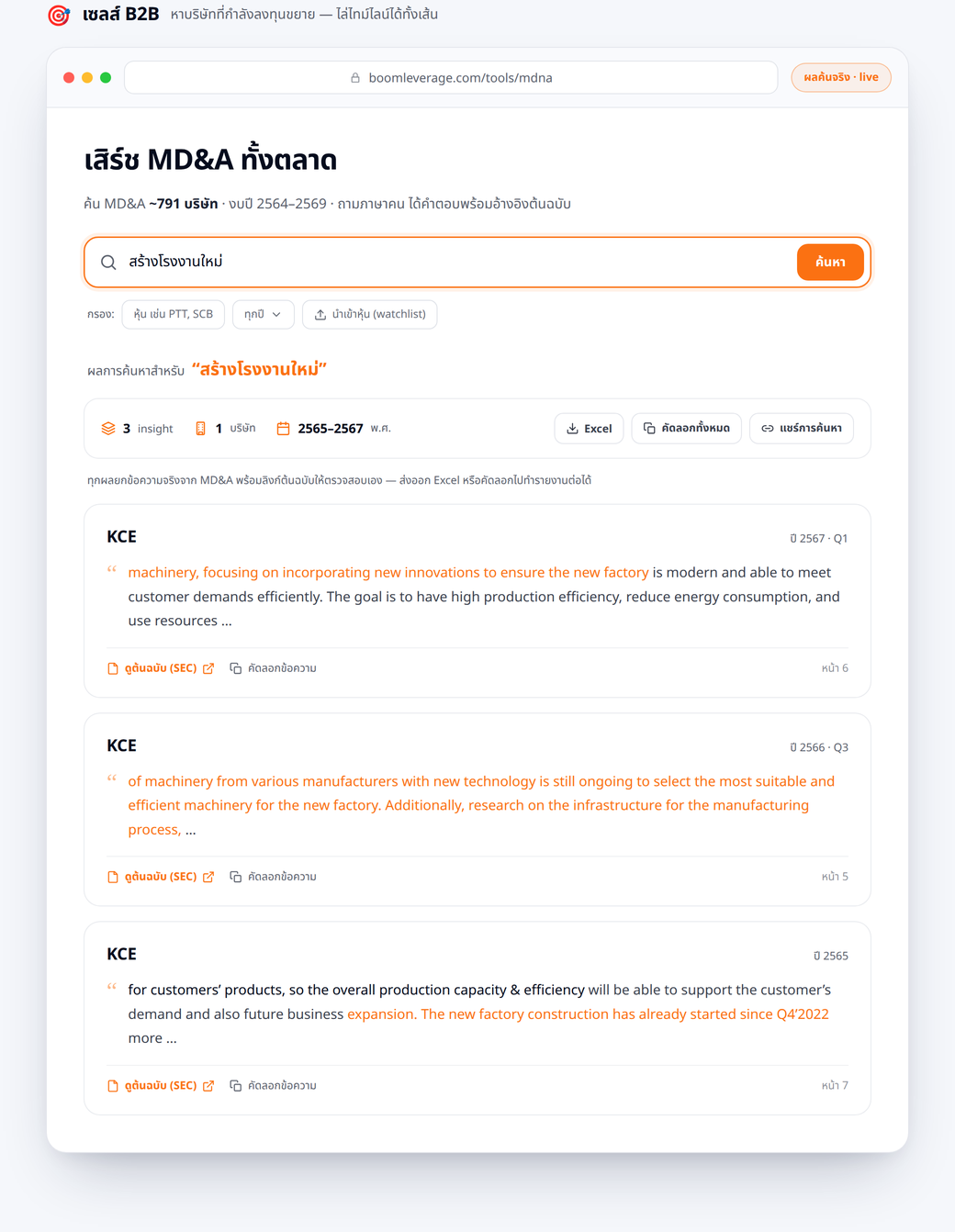
Searching "สร้างโรงงานใหม่" [building a new plant — capex already committed] on the live tool: KCE on the new factory across several years, the whole expansion timeline in one screen, every card linked to its 56-1 source.
Why it's money: the rep holding this list doesn't just know KCE is building a plant. They see the entire timeline — which quarter it started, how far it has gone, what language the company uses — and they pick up the phone when the timing is right, carrying enough context that the call is not a cold call but "I see you're expanding capacity..." That is the difference between the rep who closes and the rep who gets hung up on.
🎯 The retail version — read the capex cycle before it reaches the numbers
Same query, character for character. You are not selling anything to KCE. You are working out where in the investment cycle this company sits — which is something the financial statements always tell you later than management's own words do.
Seeing the full capex timeline means you can read it: mid-build = cash going out, depreciation coming, cash flow temporarily tight → post-completion = new capacity running, revenue with a new source. The investor who knows which point of that line a company occupies and the investor who sees one weak quarter and panic-sells are not the same investor.
The more powerful question is the inverse — "บริษัทไหนเคยประกาศขยายกำลังการผลิตแล้วปีนี้เงียบไป" [which companies announced a capacity expansion and have gone quiet on it this year]. A project that disappears from management's mouth usually disappeared for a reason nobody announced.
Department 2 — Strategy / Market Intelligence — find where the competition is bleeding without hiring a research firm
Say I run strategy at a consumer goods manufacturer. I want to know what pressure my competitors in the same industry are under, cost pressure above all — because if their margin is being squeezed, I can price and promote against it.
I search "ต้นทุนบรรจุภัณฑ์" [packaging cost — the input that moves before the margin does] to see who along the manufacturing and packaging chain is talking about cost pressure:
intel = mdna.search("ต้นทุนบรรจุภัณฑ์", top_k=5)
top = intel["results"][0]
print(top["ticker"], top["fy"], top["period"])
print(top["snippet_verbatim"])
Live result — number one is MBAX (Multibax, plastic packaging), and it doesn't merely say costs went up. It hands over the margin:
MBAX · 2025 (Q1): "These factors resulted to the higher raw materials cost used in production and the cost of sales. Nevertheless, the company continuously controlled the expenses proportionately... the gross profit for the first quarter of 2025 had been recorded at 35.40 million Baht, increased by 6.16 million baht or 21.07 percent."
— verbatim from MBAX's MD&A · the SEC original
Want it more granular? Search "วัตถุดิบแพง" [raw materials have gotten expensive — the phrasing that surfaces when input prices bite] and SITHAI (Srithai Superware) comes back naming the exact resin grades and what each one goes into:
SITHAI · 2023 (Q3): "In Q3/2023, main raw material prices were lower than the same quarter... PP COPO for paint pails, containers, and battery cases - PP HOMO for furniture - HDPE for pallets, garbage bins, crates... - PET for preform"
— verbatim from SITHAI's MD&A · the SEC original
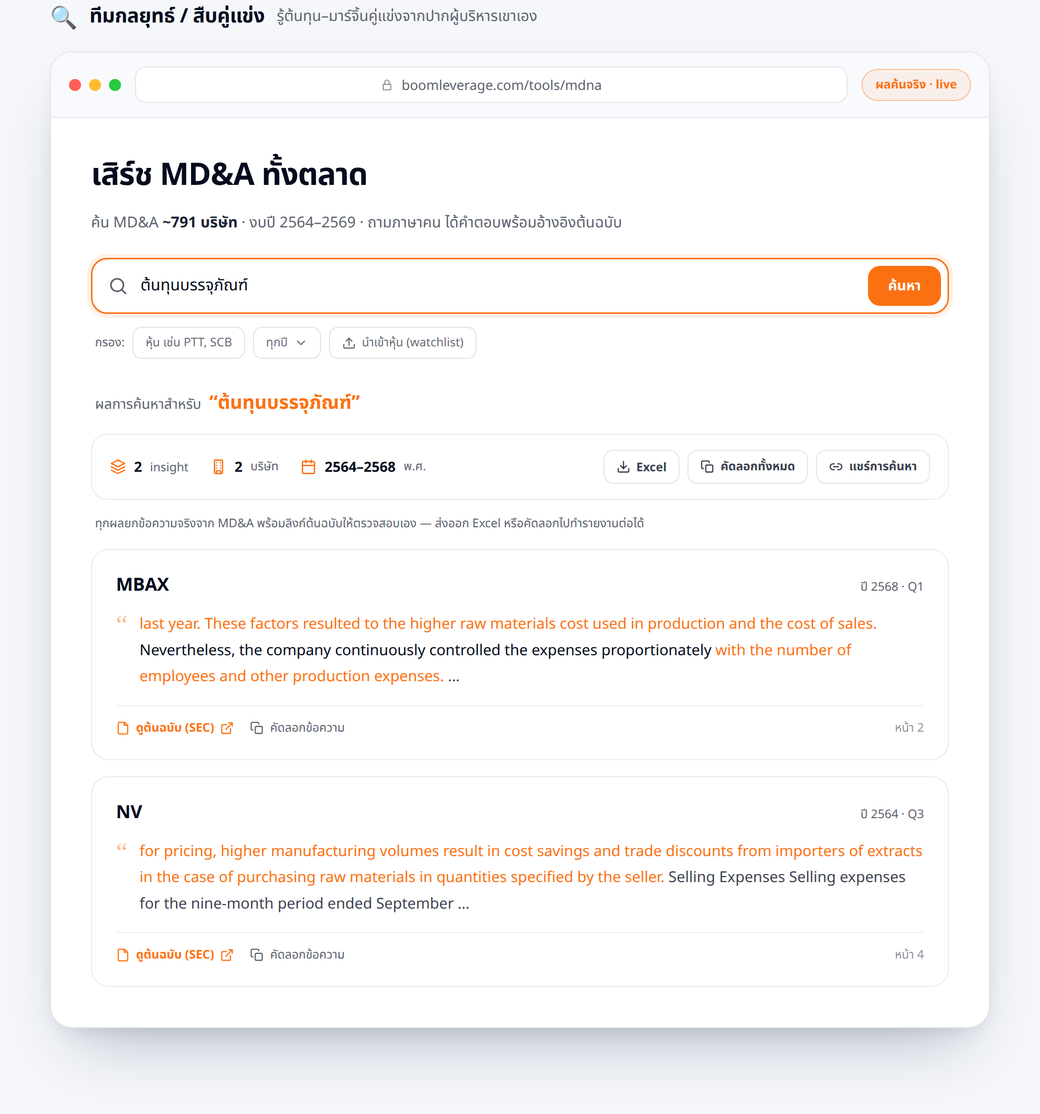
Searching "ต้นทุนบรรจุภัณฑ์" [packaging cost — what the competition is carrying] on the live tool: competitor margins and competitor cost control, same line of business, out of their own management's mouth.
Why it's money: this is competitive intelligence at the level you normally buy from a market research firm for six figures — you know the competitor's margin, you know which input they are carrying, you know whether their expense control kept pace. All of it from their own management rather than from a guess, and comparable across years so you can see which way the tone moved.
🎯 The retail version — scan for the names in your portfolio about to lose margin
This is the case I think fits retail best in the whole article, and the one I want you to actually run.
Margin never contracts without warning. It goes in sequence, every time: costs rise → management starts writing about it in the MD&A → margin finally contracts in the reported numbers → the share price finally reacts. Most people arrive at stage 3 or 4, when stage 2 is a public document anyone can read for free.
Timeline of a margin about to be squeezed

  ① Input costs actually rise out in the world
        │  (nobody in the equity market is talking about it yet)
        ▼
  ② Management writes it into the MD&A  ←──── ⭐ you read it here, free, on the record
        │  "ราคาวัตถุดิบหลักปรับตัวสูงขึ้น..." [main input prices moved up]
        ▼
  ③ Margin visibly contracts in next quarter's numbers
        │  (the sell side starts publishing)
        ▼
  ④ The share price reacts ← where most people find out
How to run it on your own portfolio — search ต้นทุนวัตถุดิบแพง and see whether anything you hold comes up. If it does, two more steps:
- Click through to the source and read the full context — can they push the cost onto customers, or are they eating it? Those two end very differently. MBAX above is the clean example: costs genuinely rose, and gross profit still climbed 21.07% because expense control kept pace. Read the headline "costs up" and sell, and you read it wrong.
- Compare across years — did they say this last year too? Is the tone heavier or lighter? A company that starts saying it this year having said nothing last year carries far more weight than one that repeats it annually.
The strongest version is reading the whole sector at once. If every competitor in the group is discussing cost pressure except the one you hold, that either means a real structural advantage or it means they simply have not said it yet. Both are questions to chase, not conclusions.
Department 3 — Credit Analysis / Credit Risk — early warning before a loan turns into an NPL
This is the tool's birthplace. Say I'm a loan officer / credit risk analyst covering a large corporate book. What the bank wants above everything is an early warning system — catching the strain before the loan sours, because early means you can freeze the line or get them to the restructuring table in time.
I search the language of debt strain — "เลื่อนการชำระหนี้" [pushing the repayment back — the polite form of cannot pay on time]:
watch = mdna.search("เลื่อนการชำระหนี้", top_k=8)
for r in watch["results"]:
    print(r["ticker"], r["fy"], r["period"], "→", r["source_url"])
Live result — the system surfaces passages on debt restructuring, such as BAM (Bangkok Commercial Asset Management), walking through its payment-holiday and principal-reduction programme step by step:
BAM · 2025 (Q2): "Monthly payments are reduced... Interest is suspended for 3 years, and if the debtor complies with all program conditions, the suspended interest will be fully waived... 'Pay, Deal, Complete' – Relaxed debt restructuring terms... For debtors with unsecured NPLs (e.g., credit cards, personal loans), debts are restr..."
— verbatim from BAM's MD&A · the SEC original
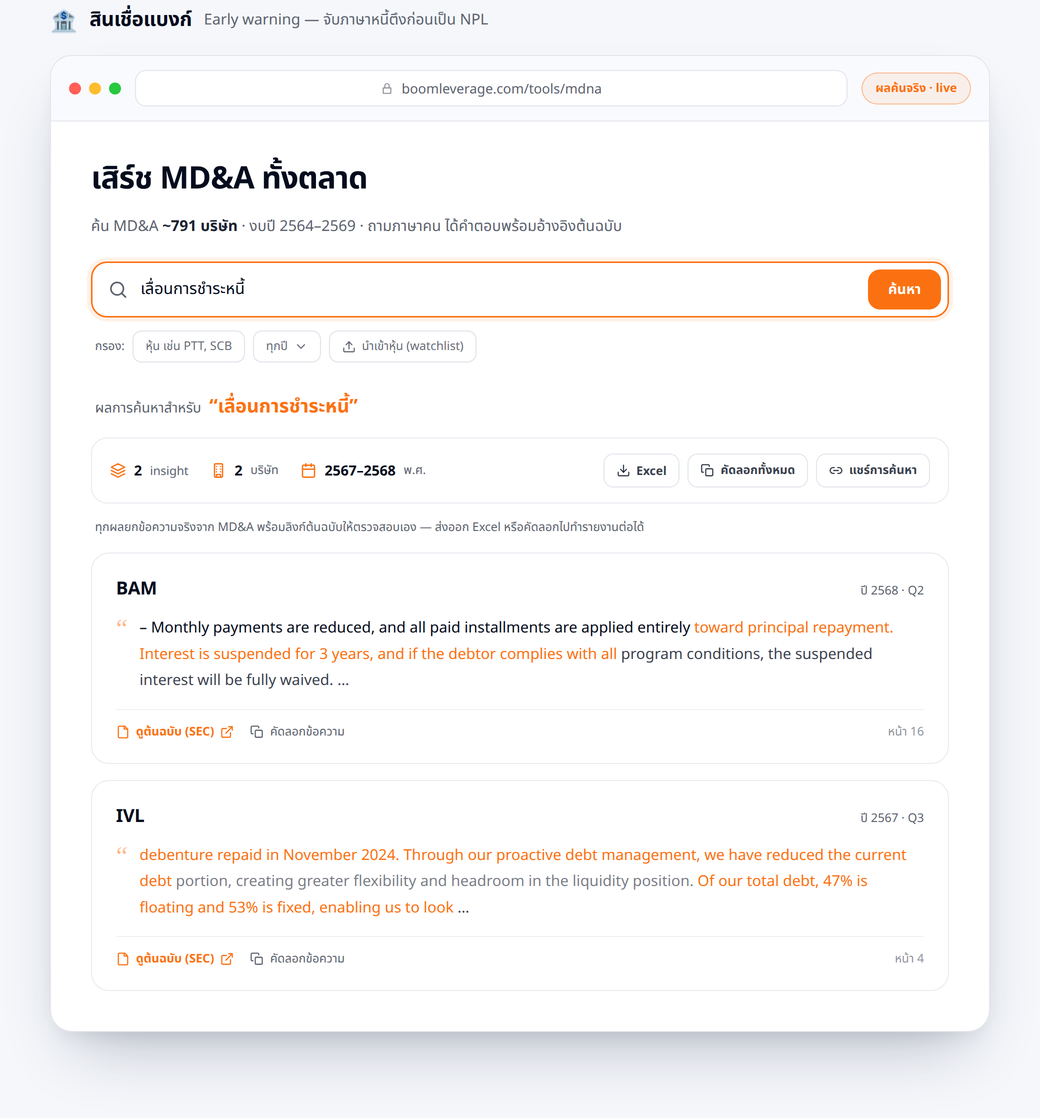
Searching "เลื่อนการชำระหนี้" [pushing the repayment back] on the live tool: sweep the entire borrower book in one pass, hunting strained debt language before it becomes an NPL.
Why it's money: for credit, searching the language of risk — "สภาพคล่อง" [liquidity, a word that gets written down when there is a reason to write it down], "ค่าเผื่อหนี้สงสัยจะสูญ" [the allowance line — receivables they have stopped expecting to collect], "เงื่อนไขเงินกู้ (covenant)" [loan covenants — somebody is watching a ratio], "refinance" — and sweeping the whole borrower book in one pass collapses a day of manual work into a single question. Banks budget millions of baht a year for tools in this category, because one NPL caught in time pays for the year. I wrote up building a text-based early warning system inside a bank in NLP Early Warning System.
🎯 The retail version — tightening financial language is the red flag that lands before the default headline
If retail takes one lesson out of this article, I want it to be this one, because the damage from holding a company whose accounts break is asymmetric — a missed gain costs you opportunity; a company that genuinely cannot service its debt costs you principal.
Banks call this early warning, and there is nothing magic in it. It is reading whether the company has started using the language of people looking for money to plug a hole. Run these against what you hold, especially anything with high D/E or bonds coming due:
| Query | Language that shows up in the filing | How to read it |
|---|---|---|
เลื่อนการชำระหนี้ | debt restructuring · extended repayment schedule | the creditors have already had to stretch |
ต่ออายุหุ้นกู้ / refinance | a new bond issue to redeem the maturing one | cash cannot repay it, so they roll |
เงื่อนไขเงินกู้ / covenant | asking lenders to waive a condition | they are at the ratio ceiling the loan agreement set |
สภาพคล่อง | an unusually long account of cash flow management | the longer and more defensive it runs, the more it deserves your attention |
The length of the explanation is a signal in itself. A company with normal liquidity writes about it briefly. A company under strain writes at length, with contingency plans and reassurances attached. That is what a credit officer reads before the numbers go bad.
A limit I have to state plainly, because it matters more than the sales pitch: this method catches only what the company wrote down. If a company is deliberately concealing something or dressing the accounts, the MD&A will not warn you — the person writing it is the person concealing it. Do not use this tool as a guarantee that any stock is safe. It tells you where to read next. It does not decide for you.
Department 4 — The business newsroom — a headline with evidence under it, in minutes
Say I'm a business journalist who has to turn copy against the cycle every day. The job is an angle with something real under it, not floating opinion.
When a topic runs hot — the flood of Chinese goods, or Beijing's push on domestic consumption — I search "นำเข้าสินค้าจีน" [imports of Chinese goods — who names China as a factor] to see which Thai companies discussed the impact in their own management commentary:
angle = mdna.search("นำเข้าสินค้าจีน", top_k=10)
for r in angle["results"]:
    print(f"- {r['ticker']} (ปี {r['fy']}): {r['snippet_verbatim'][:80]}...")
Live result — BEAUTY (Beauty Community), stating the hit directly: the Chinese market shifted behaviour toward Chinese-made goods over imports:
BEAUTY · 2021 (Q2): "For the overseas market, particularly the Chinese market, most customers now switch to buying more Chinese-made products online in response to the government's policy aiming to promote consumption of domestic products and thus imposing more restriction on foreign imported goods..."
— verbatim from BEAUTY's MD&A · the SEC original
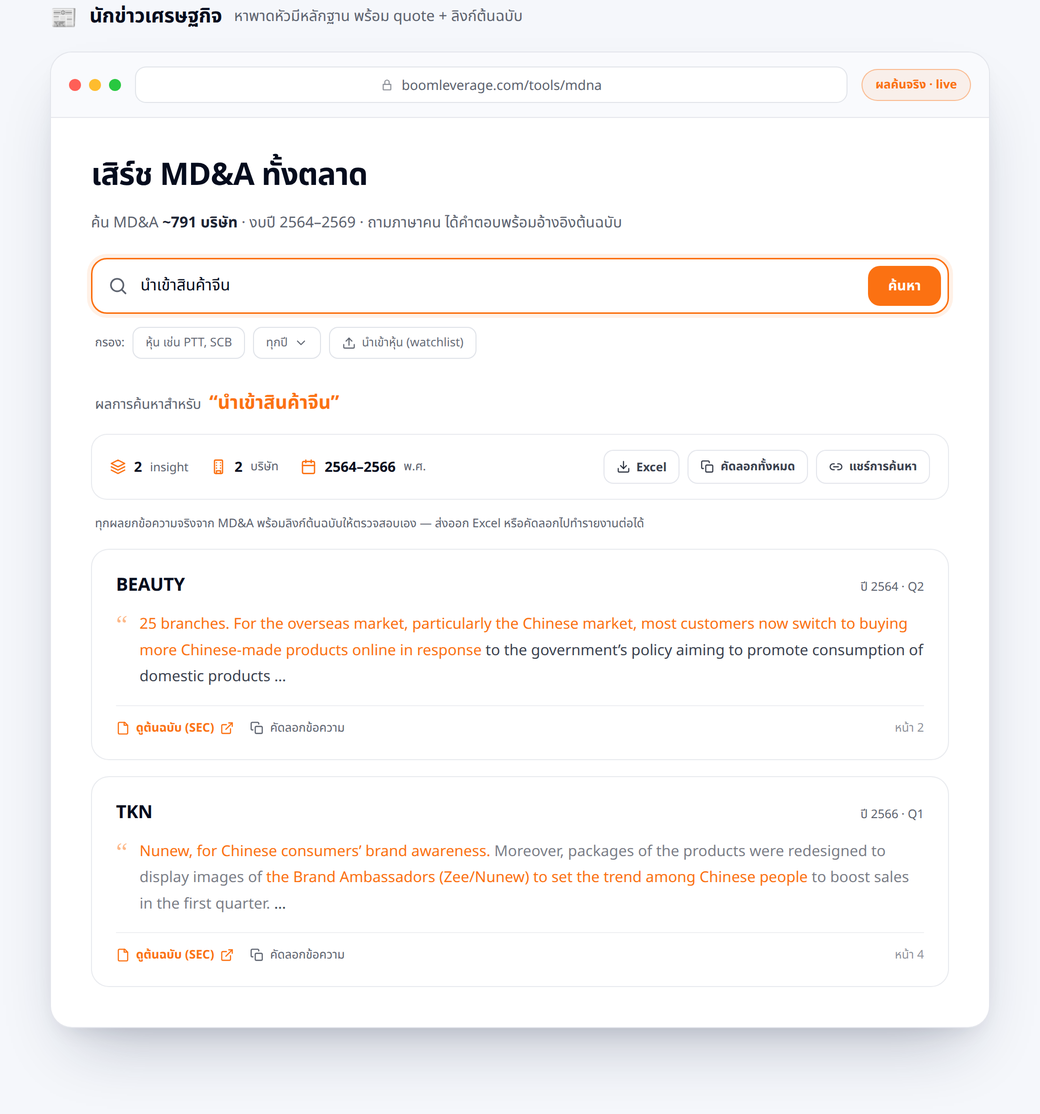
Searching "นำเข้าสินค้าจีน" [imports of Chinese goods] on the live tool: story material with company quotes and 56-1 links ready to cite.
Why it's money (and PR for us): one question and the journalist has enough to write "The Thai companies caught by Beijing's domestic-consumption policy" — with a company quote plus the source 56-1 link ready to cite. Work that used to mean reading a dozen reports takes minutes.
🎯 The retail version — catch a sector theme before it becomes a headline
Journalists and investors do nearly the same work; only the destination differs. They find a theme to write. You find a theme to position.
When macro news lands — currency, tariffs, foreign policy, energy prices — the question that makes money is not whether the news is good or bad. It is "บริษัทไหนบ้างที่เขียนไว้เองว่าโดนผลกระทบนี้ และเขียนไว้ตั้งแต่เมื่อไหร่" [which companies wrote down themselves that this hit them, and how far back the writing goes] — answerable in one search.
What you get from it is the ordering: which company was writing about this in 2021 and which one only started in 2025. The first saw it early and has probably adjusted. The second just got hit. Headlines never give you this, because news reports the event, not each company's timeline.
What all four departments share: why the institution and the retail investor get the same product
All four run the same tool for different value, because they have the same problem — bank or lone investor at home: the market is full of valuable documents and nobody has time to read them all. It gets solved by three things you cannot get from Ctrl-F or a general chatbot:
- Ask in human language, not exact strings — type "ใครกำลังลดพนักงาน" [who is cutting headcount] and it still hits when the company wrote "ปรับโครงสร้างองค์กร" [organisational restructuring — the polite version of layoffs] or "reduced workforce" — because the system matches meaning, not characters (how this differs from keyword search)
- Sweep the whole market, years deep, in one pass — 926 listed companies, FY2021–FY2026: who spoke first, who changed their stance, compared across years, instead of one file at a time
- What cannot be verified against the source is not shown — every line returned carries the source text verbatim, plus company, year, and a link to the 56-1 file the SEC published. Anything that cannot be matched back to the file word for word is quarantined, and the system tells you how many it held and why
That last one is the core, and it turns the question from "can I trust the AI" into "how fast can I check it." Financial work cannot lose on accuracy. A good tool makes you faster at checking, not comfortable with not checking.
What this normally costs — and why I opened it to retail
Money, straight, because it is the reason this article exists.
A tool that does everything you just read normally lives in institutional territory. Competitive intelligence at that level means hiring a research firm for six figures. Text-based early warning means a bank standing up a data science team to build the pipeline itself — months, headcount, millions of baht before anyone uses it.
I know because I was the person building that pipeline inside a bank.
And what I built this time is still built for enterprises: a desk licence — multi-seat, 100-row Excel/CSV export, API into existing systems. The ALPHA ฿9,900/month pack is priced for what sits behind it. When this article first ran it was a dated waitlist, because it promised 10 years of depth while the older years were still being extracted and I will not sell a window that is half empty. Those years are now in the searchable index, and findings from before FY2021 are withheld unless their quote has been verified against the source PDF — so the depth is real and provable, and the pack is open. There is still no checkout button: seats, export volume and API rate are agreed per team, so the route is the Enterprise page.
But here is the fact I want visible: the expensive part of a tool like this is building the pipeline, not asking it a question. Once the pipeline exists, one more person asking costs almost nothing extra. So hoarding it for enterprises paying enterprise prices is not a cost decision. It is purely a pricing one.
So I opened the web app to the same questions, on the same index, behind the same source-verification gate:
| Institution | Retail on the web app | |
|---|---|---|
| Index searched | 926 companies, FY2021–FY2026 | the same index |
| Verbatim gate + SEC link | yes | the same gate |
| How you use it | API wired into the team's pipeline | type a Thai question into one box |
| Full Excel export | yes (desk licence) | included on paid plans |
| History depth | 10 years on the ALPHA desk licence; 6 on the self-serve ladder | free ~1 year and change · DELTA 4 years · GAMMA 6 years |
| Price | ALPHA ฿9,900/month — scoped and sold by conversation | ฿0 · ฿799 · ฿1,399/month — self-serve, live today |
The difference is seats, volume and depth. Not the quality of the answer. The line a retail user sees is the same line that cleared the same gate the enterprise sees.
Five questions to copy and make your own standard
What produces results is not the tool. It is asking the same set of questions every single time — otherwise you ask differently each round and the outputs are not comparable. This is the five-point frame I used reading MD&A company by company at the bank. Take it as your personal (or departmental) checklist:
- 1. Did the tone shift against last year — did words that used to be "มั่นใจ/เติบโตแข็งแกร่ง" [confident, growing strongly] turn into "ระมัดระวัง/ท้าทาย/ติดตามใกล้ชิด" [cautious, challenging, watching it closely — the vocabulary of a company hedging]? A downgrade in confidence is the earliest signal and usually arrives ahead of the numbers. Ask: "บริษัทไหนเปลี่ยนน้ำเสียงจากมั่นใจเป็นระมัดระวังเรื่องยอดขายหรือกำลังซื้อ" [which companies flipped from confident to cautious on sales or purchasing power]
- 2. When did they start naming cost and margin pressure — energy, raw materials, wages, a higher interest burden: these usually appear in the MD&A before margin contracts in the statements. Ask: "บริษัทไหนเริ่มพูดถึงต้นทุนพลังงานหรือภาระดอกเบี้ยที่สูงขึ้น" [which companies have started flagging higher energy costs or a heavier interest load]
- 3. How do they talk about liquidity and debt — look for refinancing, loan covenants, cash flow management. The longer and more defensive the passage, the more attention it deserves. Ask: "บริษัทไหนพูดถึงความกังวลเรื่องการ refinance หรือภาระหนี้ที่เพิ่มขึ้น" [which companies are voicing refinancing worry or a rising debt load]
- 4. Do they blame the outside or own what was theirs to control — when results are weak, does management attribute all of it to the economy, the currency, factors beyond their control, or do they admit the part that was management? Candor is a signal of management quality. Ask: "บริษัทไหนอธิบายผลประกอบการที่อ่อนแอโดยโทษปัจจัยภายนอกเป็นหลัก" [which companies explain weak results mainly by blaming external factors]
- 5. What did they say every year and drop this year — what disappears usually matters more than what gets added. A project they promoted, a major customer they named, a target they kept repeating: if it suddenly goes quiet, that is the question to chase. Ask: "บริษัทไหนเคยพูดถึงการขยายกำลังการผลิตแล้วปีนี้ไม่พูดถึงอีก" [which companies used to talk about capacity expansion and have stopped this year]
From the model validation seat: none of the five asks which stock is good — all five hunt risk signals, not buy or sell instructions. It is the same frame used to assess borrower risk inside a bank, pointed instead at the public disclosures of listed companies. And for retail it carries an underrated property: it tells you when to do nothing, which is the single most profitable decision available over a long horizon.
Why you need a tool at all: these five questions are easy to run on one company by hand. Open this year's MD&A next to last year's, read, note what changed. The only problem is scale — if you follow dozens of names, or want to know who across an entire sector started saying the same thing, reading file by file across several years is not work a human does. That is the gap I hit myself, and had to fix.
Four limits to know before you pay
I came out of model validation. My old job was finding the point where other people's models break, so here is my own list in full — if any one of these is a deal-breaker, I want you to know it before you pay, not after:
- This tells you where to read. It does not decide for you. Semantic search returns the passages closest in meaning, so it sometimes pulls text that only grazes the point, because management language is oblique and varied. Your job is to click the link, read the full context and judge. Same rule model validation lives by: a result you cannot trace back is a result you cannot use.
- Coverage is the full market — but the latest fiscal year is still running. 926 companies, SET and mai, FY2021–FY2026, every book filed. The remaining caveat is that FY2026 is not closed, so most of it is quarterly filings, not full annual reports.
- Year depth is tied to the plan — free shows about a year and change · DELTA 4 years · GAMMA 6 years. Reading across time takes depth. If your use case is a 5–6 year comparison, do not buy the bottom plan and be disappointed.
- This is not investment advice and was never designed to be. The tool searches management commentary for signal and context. It does not tell you which stock is good or what to trade. And to repeat the point from the credit section: it reads only what the company wrote itself. Accounting dressed up, or concealment that never made it onto paper, is invisible to it.
Try one question as an institutional analyst
If you have read this far, run it rather than believe me. And I have one question I want you to run first:
Go to terminal.boomleverage.com and type
สร้างโรงงานใหม่
That is the same question the B2B rep used in the first section to find customers with budget — and you are about to get a list of companies that have announced capacity expansion, with the real sentences out of management's mouth and the 56-1 file linked for checking. In seconds. Free, 100 credits/day, no card.
Then, to see how serious it is, run the other two from this article: ต้นทุนวัตถุดิบแพง (see whether anything you hold comes up) and เลื่อนการชำระหนี้ (see which name deserves a closer read of the accounts).
| Where you are | Start here | What you get |
|---|---|---|
| Want to try it without talking to anyone | terminal.boomleverage.com | Free, 100 credits/day, no card — fire the five questions above at it, then read the pack selection guide if you need more depth |
| Using it seriously on your own portfolio | Pricing | DELTA ฿799/month (4 years · 150 credits/day) · GAMMA ฿1,399/month (6 years · 350 credits/day) · annual = pay for 10 months |
| Whole department / has to fit an existing process | Enterprise page or contact@boomleverage.com | A desk licence: multi-seat · 100-row Excel/CSV export · API. The ฿9,900 ALPHA pack (10 years · 1,500 credits/day) has no buy button on purpose — it is scoped in the conversation that starts here |
You get me, not a sales team: email in and the reply comes from me (Varanchai), the person who built it. Tell me straight what question you need answered and I will tell you straight whether what exists today answers it — and if it doesn't, I'll say it doesn't.
Deeper reading:
- How semantic search differs from exact-keyword search, and why that matters
- Reading MD&A across time — the Precious Shipping case, FY2021
- Finding alpha in management's own words — scanning every 56-1 across SET and mai
- Labour cost vs cost of capital at Thai companies, 2022–2026 — a full-market scan
- I built an NLP Early Warning System inside a bank first
This content is for education and sourced analysis, not investment advice · The individuals in each case are hypothetical, used to illustrate the workflow, but every search result and every passage quoted is real, taken from Form 56-1 filings that listed companies disclosed publicly through the SEC.
Read next
Type the Theme, Not the Year: How to Ask AI About Thai Stocks So the Answer Comes From the Filings, Not From Your Question
Read more MD&ACtrl+F Doesn't Just Miss — It Finds the Wrong Thing, and on Some Files It Sees Nothing at All: Three Layers of Information Investors Lose in Thai Filings
Read more MD&AOne Red Flag Was Never Enough: I Counted 104,153 Lines Thai Companies Wrote About Themselves, and All Six Lenses Lit Together Only 9 Times
Read more