Thai equities, read forensically
Search the opportunity and the risk written into every listed Thai company's One Report — management discussion, financials, and the auditor's own opinion — six years deep. Every result points back to a page in the source filing. What we cannot verify, we withhold, and we tell your team how much and why. Built by a former Model Risk Manager from inside a bank.
Talk to us / request a demoWant to test the claim before you talk to us? Nothing to buy: download the control document we published with its answer key stated up front and run it against your own tooling, or open 1,153 cited passages and click straight through to the filings at the regulator.

Seats for the whole desk
Your analysts on the Terminal at the same time, searching every listed company's One Report six years deep. Seat count scales with the team.
- The entire market, refreshed every quarter
- Search the thesis or the risk you are chasing, not a keyword
- Access managed at the organisation level

Export into the process you already run
Pull the result set out as a file — verbatim source passage and citation link included — and drop it straight into the analysis workflow your team already has.
- Findings, source text and citation link in one export
- A format you can actually model on
- Every row traceable back to the filing

API into your internal stack
Call One Report intelligence directly from your tools, dashboards or research pipeline — the same corpus and the same engine that serve the web app.
- Programmatic access to the identical corpus and engine
- Wire into the analytics and dashboards you already have
- Scope and rate limits agreed against real usage
Exported, and still traceable row by row
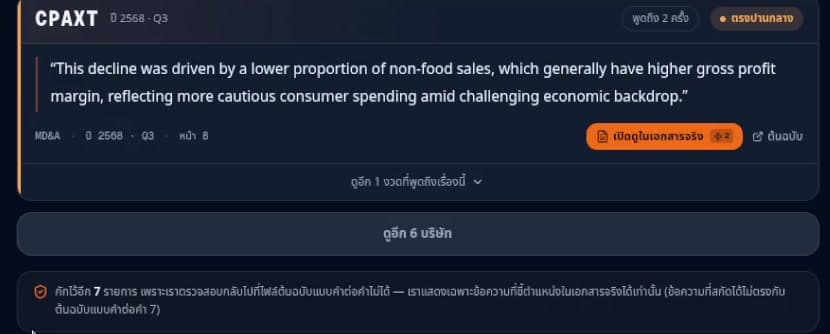
The actual downloaded file — verbatim source passage in one column, the SEC filing link in the next
Auditor opinion
BetaRead what the auditor chose to write about the company — Key Audit Matters, modified opinions, going-concern observations — searchable across companies and across years in one place, every item cited to the original audit report.
Still beta because the corpus is shorter than the MD&A one — not because the evidence is weaker. Every row clears the same gate as the rest.
Operating quality
BetaRead the MD&A a company wrote about itself through six lenses — customer concentration · FX hedging · inventory quality · working capital · labour restructuring · litigation and governance — searchable across companies and years in one place. Every item is the company's own wording, with the page number to open the original.
Still beta because it only opened for search on 27 Aug 2026 — not because the evidence is weaker. Every row clears the same verification gate as the other axes, and carries the relevant accounting standard alongside it.
Priced against team size and scope of use — that is a conversation, not a price card.
We publish the denominator, not just the numerator
Every result your team sees has already been matched word-for-word against the source filing. What could not be matched is withheld, with the reason attached — it never arrives mixed in with the rest.
99.0%
of findings verified against the source
489,518
findings that point back to a page in the filing
5,205
withheld — never shown to a user
What withholding is — and what it is not
The gate is a word-for-word string match between a candidate passage and the source document. It decides on whether the text can be located, and it cannot read: it has no view on whether a passage is favourable or damaging to the company it came from. Nothing is withheld on editorial grounds, and the withheld set is not where negative findings go. A row fails for one of three mechanical reasons — the filing is a scanned image, the source file has not been fetched yet, or the extracted text does not match the document character for character.
Withheld also does not mean deleted. The rows are quarantined and labelled, the count is published here rather than kept internal, and in the product a user can choose to reveal near-miss rows behind a warning. We quarantine and label; we do not delete, and we do not decide for the reader.
| Searchable axis | Total findings | Verified |
|---|---|---|
| Results & financial position | 214,633 | 98.7% |
| Risk factors | 147,366 | 99.3% |
| Business & competition | 65,771 | 98.8% |
| Governance | 52,710 | 99.1% |
| Auditor opinion (beta) | 14,243 | 99.7% |
Measured over the axes in this table (FY2021 onward — the same window every plan can reach) · as of 20 Oct 2026, 21:01 · reasons for withholding: the document is a scanned image · no source file yet · the text does not match word-for-word
These axes are the denominator — the rows above sum to the figures in this block. Material the terminal serves only when a request names it — SET announcements, insider reports (Form 59), major-holder filings (246-2) and ESG reports — is evidenced by a deep link to the publisher's original rather than a word-for-word match in a filing we host, is measured separately by the same gate, and is not counted here.
99.11%103,530 of 104,461 findings verified word-for-word against the source filing
Reported apart from the table above because this axis only just opened — a different denominator, not blended into the figure above — not because the standard is different. Rows that fail verification are withheld on every axis alike.
The FY2016–2020 archive — not entitled to any plan yet, ALPHA included
Years earlier than FY2021 have been extracted and indexed, and are being verified against the source filings through the same gate as the table above (254,154 of 256,090 findings so far — a different denominator from the figures above, and not added to them). Rows that have not cleared verification are not served, even though they are already in the index. We open the entitlement when the verification is done — if that era is load-bearing for your team's decision, we can talk about when and on what terms.
Need to look deeper? We will open the pipeline to you
We run an internal dashboard that measures every axis through four gates (data exists → indexed → clears the guard → actually served) and reports the status of the WORST gate, never an average — including the parts that are not finished. Teams running vendor due diligence can request access.
Request dashboard access →On-Demand Research
Point our forensic stack at one name, one sector, or one question, and get back the memo we would write for our own book — every claim carrying the filing, the page, and the line it came from.
- A written forensic memo — findings first, hedging never.
- Every assertion cited to the source filing, page and passage. Anything we cannot tie to a document does not go in the memo.
- The underlying evidence set exported to Excel/CSV, so your analysts can re-run our work instead of trusting it.
- A call with the analyst who wrote it.
If your desk does not read Thai
Every cited line arrives twice: the company's own Thai sentence verbatim, and our English rendering beside it — labelled as ours, because the Thai is the authoritative text and the translation is not the filing. The page number and the link to the document at the regulator sit on the same row. Any single claim can be put in front of a bilingual analyst, a translator, or your own Thai counsel and settled in minutes. You are never asked to trust our reading of a sentence you cannot see.
Commissioned for
- — Pre-IC diligence on a Thai name your team cannot read the filings for
- — A second opinion on a position that has started behaving strangely
- — Sector-wide screens for a specific failure pattern — related-party drift, auditor churn, working-capital rot
On-Demand Research
$1,000 / report
per report · starting price
Includes up to 3 rounds of output/format revisions to match your internal IC presentation standards.
One report costs $1,000. The Terminal runs the same engine across the entire market, every day, for a fraction of that — which is the point of showing you both prices on one page.
Built by someone who had to defend models to internal audit
Not a retail stock app. Two model-risk desks inside two of Thailand's largest banks taught the same lesson twice: a number nobody can trace back to its source does not ship, however accurate it looks. That constraint is the product, not a feature of it.
- KBank — Manager, Credit Risk Quantitative Analytics. Built the institution's first NLP early-warning system: deep learning over Thai news and disclosure text, to catch a borrower deteriorating months before it reached the accounts. That desk is where the false-positive discipline in this product comes from — a system that fires wrong gets ignored within weeks, so few alerts that are all right beats many that are sometimes right.
- KTB — Senior Data Scientist, Business Risk & Macro Research. Owned, validated and ran the production Monthly ECL Dashboard (TFRS9-ECL) — the model a bank provisions real capital against. That desk is where the citation gate comes from: hand a model to internal audit and the question is never how accurate it is, it is where this came from. No answer, no approval, at any accuracy.
- Master of Science in Physical Chemistry from Mahidol University (DPST Scholar) · former university physics and chemistry lecturer · Super AI Engineer S2 (AIAT)
- IC Complex Type-1 licence (Thai SEC) · earlier: financial adviser at Finnomena, then proprietary and quantitative trading at Mudley Group
What this does not prove
Three limits, in our words rather than yours. Each one is a thing we could have left for you to discover.
There is no backtest behind it
Nobody here has demonstrated that a company whose disclosure goes quiet defaults more often than one whose disclosure does not. So the claim is deliberately small: this tells your team whose filing to read first. It does not tell you who is in trouble — and any product that says it can, off six lenses and no study, is selling a risk score it invented.
No forecast, and no look-ahead
Everything here becomes available the day a filing is indexed, and nothing in it is available before. The edge is memory — a baseline the index is already holding, applied the moment a new document lands — not foresight. There is no model of the future anywhere in the product.
It does not alert, rank or score
The Terminal does not push your desk an alert, and there is no watchlist in the product today. It holds the baseline and answers the same question again when you ask it — the analyst still has to ask. We publish no league table, no severity score and no red-flag headline about a named company.
One more, because it is the kind a vendor never volunteers: the extraction step is not deterministic. Run the same document twice and a passage can come back once and not the next time. That is exactly why a single empty result is never treated as evidence of silence, and why a second, controlled question is asked alongside the first — an empty box on its own proves nothing.
Tell us the question your desk cannot answer
Sketch it out below and we will reply by email to scope access, terms and pricing for the team.
This service delivers analytical and educational information with citations to source documents. It is not investment advice, not a solicitation to trade, and not a price target.