Read what management actually said — across the whole Thai market, and prove every line
The MD&A is management's own voice, and it is buried inside tens of thousands of PDFs from ~926 listed companies that nobody can search across. Type the idea — “supply chain disruption” — and pull the real sentences from every company that discussed it, in whatever words they chose, going years back. What we cannot verify against the original document, we do not show you — and we tell you how much was withheld and why.
We do not show what we cannot prove
Every line you see has been matched back to real text in the original Form 56-1 — page and position on the page, openable immediately. What cannot be verified word-for-word we withhold, and we tell you how many and why. Not deleted, and not decided on your behalf: inside the terminal you can ask to see the near-misses yourself.
- verified against the source filing(FY2021 onward)
- 99.0%
- 489,518 of 494,723 findings
- withheld — never shown to a user
- 5,205
- scanned image · no source file yet · text does not match word-for-word
Measured over Results & financial position, Risk factors, Business & competition, Governance and Auditor opinion (beta) — the axes we publish coverage for, FY2021 onward. Material the terminal serves only on request is proved by a link to the publisher's original and measured separately; the full breakdown is on the coverage page.
As of 20 Oct 2026, 21:01
99.11%verified against the source · 103,530 of 104,461 findings
This axis only just opened, so its number is reported on its own denominator — not blended into the figure above — and every line clears the same verification gate.
FY2016–2020 archive · on the ALPHA desk licence
The earlier years are extracted, indexed and verified line by line against the source filings to the same standard as above — and they are included with ALPHA, the desk licence, which reaches FY2016 onward. The self-serve plans reach FY2021 onward. Any finding older than FY2021 is withheld unless its quote has been matched to the original filing.Archive coverage: 254,154 of 256,090 findings verified — a different denominator from the figures above, and not added to them
Request the coverage report and access to our pipeline dashboard
Questions this actually answers
Write it the way you would say it. The engine searches every company and every year, then hands back the source passage and the filing link so you can check it yourself.
“impact of a weaker baht”
→ The companies, and the sentences where management discussed FX, with the fiscal year and the source filing beside each one
“weakening purchasing power at the low end”
→ Only the passages that discuss bottom-of-pyramid demand, pulled across many companies in one click
“rising energy and electricity costs (filtered to FY2022–2023)”
→ Who flagged it early and who flagged it late — the sequence of recognition, across years
“consumption outlook (filtered to CPALL, CRC)”
→ Each company's own words placed side by side, with an AI summary of who said what — every line cited. The conclusion is still yours
“higher ECL provisioning driven by NPLs”
→ The credit-risk narrative across the sector, with the source document for each claim
“shifted from caution to expansion (latest filings only)”
→ Tone changes between reporting periods, evidenced by the passage that changed
What you get
Not raw data. Evidence you can put in front of a committee.
Built for three kinds of reader
Analysts and portfolio managers
Cover a sector or a theme in an afternoon instead of a fortnight, and screen the whole market qualitatively in one pass
Fundamental and deep-value investors
Interrogate the management narrative of every name you hold, against its own history and against its peers, immediately
Strategy, IR and advisory
Competitive intelligence — how rivals frame the same pressure, and the exact filing where their framing changed
How it works
We index the whole market's One Reports, years deep
The MD&A section is extracted from public filings (Form 56-1 One Report / annual report) for every listed company and embedded for search
You type the idea you are chasing
Vector search finds passages whose MEANING matches, across every company and every year — not just the ones that used your exact words
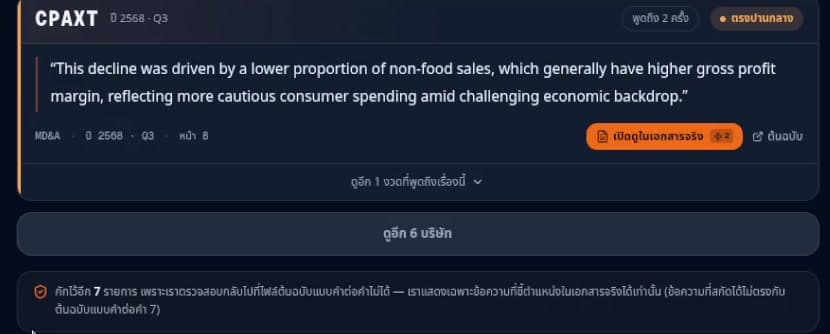
You get the real passage, cited — and the unprovable is held back
Before anything renders, each line must match word-for-word against text in the original filing. What fails is withheld, and the count and the reason are shown to you. Nothing passes silently
Why us
- Semantic vector search — you search meaning, not strings, so you find the company that said it in words you did not think of, in Thai or in English
- An MD&A corpus covering ~926 listed companies, years deep, tens of thousands of documents, already indexed — nothing else lets you query Thai filings this way
- Continuously refreshed — new and revised Form 56-1 filings are pulled from the public source twice a day, catching new quarters, late filers and amendments, and always serving the latest version
- We do not show what we cannot prove. Every line is matched back to real text in the original filing before it reaches you; anything that fails word-for-word verification is withheld, counted and explained — not deleted, and not decided on your behalf
- Boom Leverage AI on top of the results — who gains, who loses, who hedged, one line per company with a [n] back to the page or the Opp Day minute; a line without a source is withheld, and a withheld summary is not charged
- Built by someone who ran risk and data inside a Thai bank, and knows what an MD&A is worth reading for
And what it is not
- Not a buy or sell recommendation, and not a price target
- Not a price forecast
- Not an AI that reaches a verdict for you — Boom Leverage AI summarises what management wrote, one cited line at a time, and withholds any line it cannot tie to a filing, so the conclusion stays yours
- Findings derive from documents the companies published themselves. Check the source before you act on it
On-Demand Research
Point our forensic stack at one name, one sector, or one question, and get back the memo we would write for our own book — every claim carrying the filing, the page, and the line it came from.
- A written forensic memo — findings first, hedging never.
- Every assertion cited to the source filing, page and passage. Anything we cannot tie to a document does not go in the memo.
- The underlying evidence set exported to Excel/CSV, so your analysts can re-run our work instead of trusting it.
- A call with the analyst who wrote it.
If your desk does not read Thai
Every cited line arrives twice: the company's own Thai sentence verbatim, and our English rendering beside it — labelled as ours, because the Thai is the authoritative text and the translation is not the filing. The page number and the link to the document at the regulator sit on the same row. Any single claim can be put in front of a bilingual analyst, a translator, or your own Thai counsel and settled in minutes. You are never asked to trust our reading of a sentence you cannot see.
Commissioned for
- — Pre-IC diligence on a Thai name your team cannot read the filings for
- — A second opinion on a position that has started behaving strangely
- — Sector-wide screens for a specific failure pattern — related-party drift, auditor churn, working-capital rot
On-Demand Research
$1,000 / report
per report · starting price
Includes up to 3 rounds of output/format revisions to match your internal IC presentation standards.
One report costs $1,000. The Terminal runs the same engine across the entire market, every day, for a fraction of that — which is the point of showing you both prices on one page.
Pricing
Pick the plan by how far back you need to reach. Move up or down at any time.
FREE · evaluation
Free
Latest filings only (at least the last 5 quarters, guaranteed) — enough to find out whether this changes your work before you pay for it
Opp Day: the last 2 quarters
100 credits/day
Try it freeDELTA · 4 years of history
~฿799 / mo
≈ $25 / mo
Keep pace with the market — trend, and comparison against the recent past
Opp Day: the past 4 years
150 credits/day
SubscribeGAMMA · 6 years of history
~฿1,399 / mo
≈ $43 / mo
The deepest self-serve window — for research that has to go back further than the last cycle
Opp Day: the past 6 years
350 credits/day
SubscribeALPHA · desk licence
from ฿9,900 / mo
≈ $300 / mo
10 years of history, FY2016–2026 · multiple seats · 100-row Excel/CSV export (DELTA and GAMMA export 50) · API · 1,500 credits/day — from ฿9,900, scaled to seat count · the auditor axis (beta) is open to DELTA and GAMMA too, charged in credits
Opp Day: the past 6 years
1,500 credits/day
Talk to usPriced on seats and scope of use
1 credit = one whole-market search, or a filtered search over up to 25 companies · beyond that, +1 credit per additional 25 companies (filtering 50 companies costs 2) · the quota resets daily
What each action costs in credits, and AI limits per plan
Need the raw data in your own stack? (quant / systematic / enterprise)
A REST API that pulls the whole market's MD&A in bulk into your own models. Developer & Enterprise plans (contact sales) are on the terminal.
Rather learn it hands-on first? Boom Field Lab runs short workshops on real Terminal cases, in Thai — selected workshops include a month of GAMMA.
⚠️ This service is a search and analysis tool over public disclosure documents (MD&A), built to accelerate research. It is not investment advice, it is not a solicitation to trade any security, and it does not warrant the completeness or accuracy of the source filings. Verify the original document before acting on anything you find here.
Search the whole market's MD&A right now
Sign in with Google and start searching, no card required. The free plan covers the latest filings on 100 credits a day; upgrade when you need to reach further back, or search more often.
Open the Terminal, freeFrequently asked
How is this different from Google, or from Ctrl+F?+
We use semantic (vector) search — meaning, not literal characters. Type “energy costs” and it surfaces companies that wrote “electricity tariff pressure”, “fuel price escalation”, or the Thai equivalent, because the same multilingual embedding model is used to index and to query. You can ask in English and land inside a Thai paragraph, or the reverse. Ctrl+F searches one file you already have open; this searches every company, every quarter, every year, at once.
Why not just upload the filings to ChatGPT or Claude myself?+
You can, if the job is one company and one document. The job here is tens of thousands of documents across ~926 companies and several years, simultaneously — many multiples of any chat context window, and uploading file by file does not scale. We index the market ahead of time and search it by vector in seconds. But the difference that matters more than speed is this: a chat answers from what it remembers, and we answer from what we can prove. Every line must match back to text in the source document before it reaches you; anything that cannot be matched is withheld rather than guessed. And the corpus refreshes twice a day, instead of being frozen inside a model's training data.
How much is covered — how many axes, and how far back?+
The Terminal searches six axes extracted from the real documents: financials (MD&A) · risk factors · governance · business & competition (beta) · auditor opinion (beta — the audit report and its Key Audit Matters) · operating quality (beta — six lenses over the MD&A: customer concentration, FX, inventory, working capital, labour, litigation). Search them together or one at a time. How far back depends on the plan you hold: the self-serve packages reach FY2021 onward, and ALPHA, the desk licence, reaches FY2016 onward — ten years. The two eras are measured and reported separately and are never blended into one figure: the headline verified share on our pages covers FY2021 onward, and the earlier years carry their own coverage number. An axis that has not cleared our verification standard is not opened for search, even when the data is already in the system.
What language are the source documents in, and what happens with scanned files?+
We prefer the English filing. When a company publishes both, the ranking picks the English document first and falls back to the Thai one only when there is no English version — and you can still query in either language, because the embedding model is multilingual. For filings that are pure scanned images with no text layer, we do not scrape the raw text: the text comes from reading the page with a vision model, and OCR is used only to recover word coordinates so the quote can still be boxed on the original page. The decisive gate is not the parser, it is the verification: every line must match back to text in the original Form 56-1, and anything that fails is withheld and never rendered (measured 16 Aug 2026: 370,329 of 373,534 lines passed = 99.14%; the remaining 3,205 were withheld). We are not asking you to believe our parsing is perfect. We are giving you a way to check it, every time.
Where does the data come from, and is this legal?+
Both the MD&A and the auditor's report come from the Form 56-1 One Report / annual report — documents the company is legally required to publish — and every result links back to the source file so you can open it yourself. We sell the search and the analysis over those public documents. We do not resell any vendor's proprietary data.
Why price on years of history, and how are credits charged?+
The further back you can reach, the more of a trend you see and the more clearly a shift in management's tone stands out — so you buy the depth your work needs. Free covers the latest filings (100 credits/day) · DELTA 4 years (150/day) · GAMMA 6 years (350/day) · ALPHA, the desk licence, 10 years back to FY2016 (1,500/day). Credits are charged per ACTION, not per minute: one search = 1 credit (filtering beyond 25 companies adds 1 per additional 25) · opening the source file with the passage boxed on the page = 2 · a full single-company health check across all axes = 3 · scanning your portfolio = 2 · unlocking one company's auditor opinion = 5 (the price is on the button before you press it, and it is charged once per company per day) · following a link out to the regulator's site = free · re-running a query that is still cached = free.
Is there a free tier, and what does it include?+
Yes — the free plan searches the latest filings (at least the last 5 quarters, guaranteed) on 100 credits a day, with no card. Enough to establish whether the tool changes your work before you pay for it. The same daily budget covers every action, including auditor detail: unlocking one company's auditor opinion costs 5 credits (the price is on the button before you press it), so a free day can open several names alongside your searches. What the free plan does not give you is depth or export — it stops at the latest filings, and reaching back years or exporting results across a book is what the monthly plans are for. What your account can reach right now is shown in the box above the pricing, read directly from the system.
Is it live? How do I start?+
It is live today — sign in to the Terminal with Google and search immediately, no card required. The entitlement and history depth attached to your account are shown in the pricing section above.